Do you like living dangerously? Well, you don't have much choice. In the game of cosmic billiards, the cue ball is headed our way - sooner or later!
It’s been theorized that an asteroid only a half-mile in diameter could destroy civilization on Earth, and hundreds of such rocks are out there in space, many of them crossing the Earth’s orbit, perhaps right this minute. Did you see that one the other day? It missed us by a whisker!
In June 2011, a bus-sized chunk of real estate missed the Earth by only 7,500 miles. If this asteroid had hit the Earth, it would have blown a sizable crater in the ground, perhaps injuring or killing some hapless folks as well. And earlier in 2011, a somewhat smaller asteroid missed the Earth by only 3,400 miles!
Are you nervous yet? You should be. Everybody should. If a big enough rock hit the Earth, the climate could be disrupted so severely that plants wouldn’t grow for years or even decades. Now there’s food for thought!
Now let’s look further into the subject of asteroids colliding with the Earth and see if there’s something we can do about this potentially devastating possibility. Please read on.
Types of Asteroids
There are three types of asteroids.
Main Belt Asteroids are the ones revolving around the Sun between the orbits of
Mars and
Jupiter. Theory has it these asteroids – millions of them, in fact - are the remnants of a
protoplanetary diskthat didn’t quite come together as a planet. The largest such asteroid is
Ceres, which is about 600 miles in diameter and considered a
dwarf planet like
Pluto. The second largest asteroid in the Belt is Vesta.
Trojan Asteroids follow planets around but rarely collide with them. The most common Trojans are the ones that follow Jupiter. There may be millions of these types of asteroids as well.
Near-Earth Asteroids (or NEA’s) are the ones we should worry about. These potential killers have orbits that take them near the Earth; some even cross the orbit of the planet. These are known as Earth-crossers.As of 2010, over 7,000 NEA’s are known to exist, and as many as 1,000 of them could be as much as a kilometer (.62 miles) in diameter.
Any one of these NEA’s could have the Earth’s name on it. Of course, the ones we don’t even know about may pose a much deadlier risk!
The Dinosaur Killer Asteroid
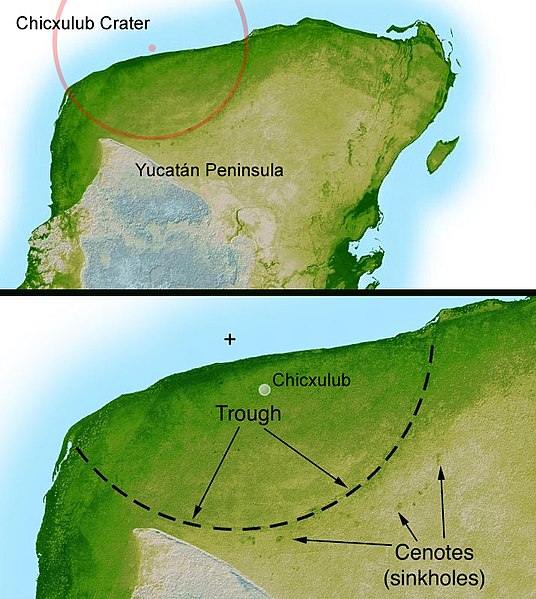
About 65 million years ago an asteroid stuck the Earth that may have brought about the extinction of the
dinosaurs. (Some scientists think continental drift snuffed the dinos, but that’s the subject of another article.) Scientists may have spotted the resultant hole in the ground, the so-called
Chicxulub Crater just north of the Yucatan Peninsula in Mexico.
It’s been estimated that this immense asteroid was six to 10 miles in diameter, roughly the size of Mt. Everest. When it landed in the ocean, it caused mega-tsunamis thousands of meters high. (Try to imagine this scene.) If an asteroid this size struck the Earth today, it could possibly wipe out the entire human species!
Meteor Crater in Arizona
If you want to see what happens when an asteroid hits the Earth, then take a look at
Barringer Meteor Crater in Arizona. (An asteroid becomes a meteor as it burns white hot in the atmosphere.) About 50,000 years ago, an asteroid struck the Earth, leaving this crater, which is about 4,000 feet in diameter and 150 feet deep. Made of nickel and iron, the asteroid that blasted out this hole in the ground was about 50 meters (54 yards) across. The energy of the impact has been estimated at 10 megatons.
You wouldn’t have wanted to be within a 100 miles of this hot spot!
Comet Shoemaker-Levy 9
In July 1994, people discovered what happens when an asteroid slams into a planet.
Comet Shoemaker-Levy 9was actually a comet, which is simply an asteroid with ice on it. As the comet orbited the planet Jupiter, it broke into smaller parts, all of which eventually fell into the planet, releasing incredible amounts of kinetic energy. The largest chunk, fragment G (about a mile across), struck Jupiter with the equivalent force of 6 million megatons of TNT, 600 times the world’s nuclear arsenal, the impact creating a dark cloud the size of the Earth!
As an aside, it’s a good thing Jupiter is out there “vacuuming up” comets and asteroids before they have a chance to the hit the Earth; otherwise, life may not have gotten a foothold on this planet because of the nearly constant bombardment over millions of years!
Tunguska Event
Nobody knows for sure what it was, but an object from space exploded over the Tunguska region in Siberia in June 1908. Most experts believe it was a rocky asteroid or comet, about 90 yards across, which detonated some 5 miles above the surface of the Earth, the explosion flattening over 800 square miles of pine forest. If the
Tunguska Event had happened over one of Earth’s mega cities, it would be similar to a 30-megaton nuclear bomb exploding in the air, likely incinerating millions of people within seconds!
Co-founder of Comet Shoemaker-Levy 9,
Eugene Shoemakerestimated that a Tunguska-like event occurs on Earth every 300 years.
Apophis
Out in space is an asteroid that may Earth in its crosshairs.
Apophis, an 800-foot chunk of rock (much larger than the Tunguska impactor), will approach the earth in 2029; and if it passes through what’s called a gravitational keyhole, then it could strike the Earth in 2036. However, the odds are very small that it will ever collide with our planet – about one in 250,000. At any rate, such an asteroid probably wouldn’t end civilization, but it could destroy any city on Earth!
Some Russian scientists caution that even if Apophis misses the Earth, it could break into many smaller parts, any of which could strike the planet.
Other NEA’s
Asteroid 2011 CQ1, which missed the Earth by only 3,400 miles in early 2011, could strike the Earth when it returns in 2022. This is not a big asteroid, but Asteroid 2005 YU55, a 1,300-foot monster, passed within 200,000 miles of the earth on November 8, 2011. If it had hit the earth, it would have blasted a crater more than four times the size of Barringer Meteor Crater in Arizona. Whew! That was a close one!
What Can We Do?
Just about any scientist will tell you that it’s only a matter of time before the Earth is struck by an asteroid large enough to cause massive damage and loss of life. What can we do about such an eventuality? Not much. But keep in the mind that there are many agencies that watch for asteroids. Chances are any asteroid miles across will be spotted months if not years before it can strike the earth, which would give agencies such as NASA and the U.S. military plenty of time to change the trajectory of the asteroid or destroy it.
But when NEA’s hundreds of feet across come around, there may be little warning. Just hope you’re not in the path of this lethal thing from space. Yet it will hit somewhere, and the most likely worldwide result will be a reduction in food production due to the massive amount of debris blown into the atmosphere. This sunlight blocking scenario would make food prices skyrocket. So, if possible, be prepared for that, however you can. (Food prices may jump skyward anyway, but that’s the subject of another article.) =[
Please leave a comment.
 Past hour earthquakes: